Showing posts with label Higher Criticism. Show all posts

Friday, June 6, 2014

The Gospel of John: Context of Authorship

John, Book of Kells (800 CE)
The Gospel of John is very different from the Synoptic Gospels in composition and content. But it is also very different in theology, and it is my aim to demonstrate it's dependence and opposition to the Synoptic Gospels, especially Matthew and Mark, and the Catholic theology they espouse. Although I am treading on ground already covered by Joseph Turmel some ninety years ago, and more recently by Roger Parvus,  [1] there is still much to be learned by a comparison between John and the Synoptic  Gospels in Catholic form. To that end I will survey some of the most obvious passages without attempting to splice the layers, with the hope of demonstrating the allegorical meaning the original author intended.

In surveying the content of the Gospel of John today with knowledge of the second century controversies, I am struck by the consistent and blunt repudiation of the Jewish God as the father of Christ, and more generally its opposition against every Jewish Christian theological point we find presented in the rest of the New Testament. It is truly a wonder this book, even with redaction, ever made it into canon.

Thursday, March 6, 2014

Marcionite Loadiceans (aka Ephesians)

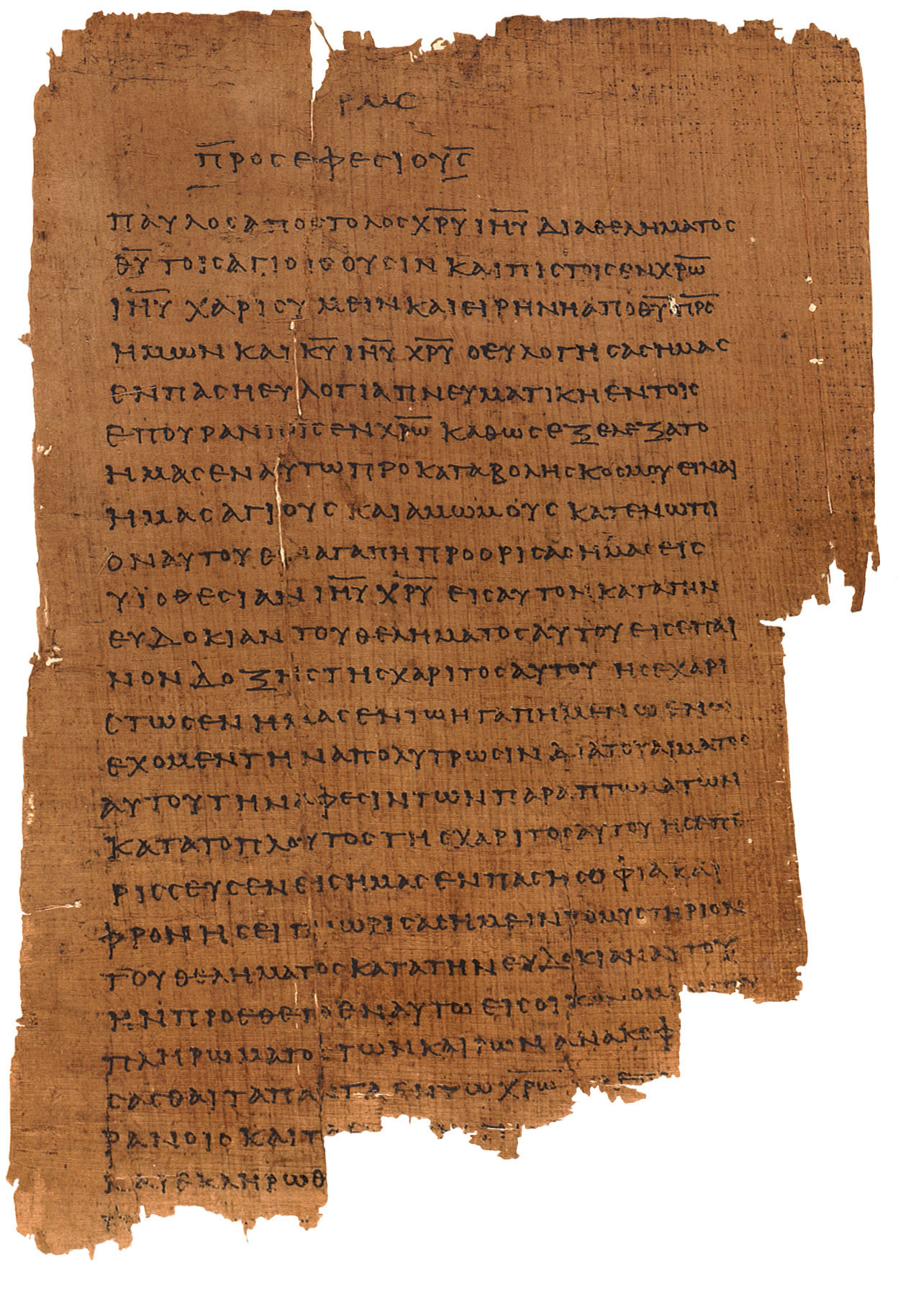
Ƿ46 Ephesians 1:1-11
The Laodiceans epistle sat 7th in the Marcionite collection. And in many ways this was the most challenging of any for me to attempt a reproduction, due both to its interwoven textual relationship with other epistles, notably Romans in the western text and Colossians, and the lack of an easy textual guide such as Swanson's to view textual variants which might be missing in the commentary of Metzger. On the plus side I found a few wonderful sites, one of which have the entire texts and plate, like the one to the right,  of P46 (along with other Papyrii) and another with Codex Sinaitiacus, and yet another for Codex Vaticanus. [1] But fortunately most of the analysis doesn't require delving into textual variants - and mind you many of those are simply transmission errors, of the sort we see in any manuscript - but instead focuses on the separation of Catholic elements from Marcionite in the unattested text; the goal being to arrived at a minimalist text that has extremely probability of actually being in the Marcionite version. The resulting text is striking and direct.

Tertullian, Adversus Marcionem 5.17.1, informs us straight out that Marcion's version of Ephesians with titled to the Laodiceans (ad Laodicenos).  What is more striking is that there was no address in the Marcionite version, exactly as we see in the picture provided of P46 nor in Codex Sinaiticus, Vaticanus (B), 1739, 424 nor miniscule 6,was any space left for an address, effectively shooting down the Lückenhypothese. However Tertullian suggests that Paul when writing to some was writing to all (cum ad omnes apostolus scripserit dum ad quosdam) does suggest the encyclical idea might be possible. But it seems more likely the author never gave an address, and all Marcion did was add Πρὸς Λαοδικέας as the superscription when the collection was put  together. This clearly shows Colossians 4:16 and the so-called Marcionite Latin Prologue to Colossians are dependent upon Laodiceans/Ephesians in Marcionite form.

Thursday, October 24, 2013

The Minimalist Approach to Marcion

Genndy Tartakovsky's Minimalist Samarai Jack
While I on and off toil away with part two, the Catholic Editor, of my three part analysis of who wrote Mark, I came in conversation with David Inglis and came up with a quick topic that needs to be addressed concerning my Interlinear reconstructions of the Marcionite text. My interlinear reconstructions seem to baffle traditionalists, because I follow a minimalist approach, but in a way that turns their world view upside down. Like Genndy Tartakowsky's fantastic cartoon, in an effort to tell the cleanest story, everything that is not required is cut away, and what is left is the purest of pure forms. And I am extremely conservative in my approach, because I do not accept any uncertain assumptions. As with the image of Jack and Aku, there may be many detail items missing, and yet no clearer picture of these characters can be had.

Sunday, August 18, 2013

Marcionite Philippians Interlinear and Notes

Chester Beatty p46 Philippians & Galatians
In the Marcionite Apostolikon Paul's Epistle to the Philippians is a rather minor book, less than half the size of the Catholic version in our bibles today. My reconstruction of Marcionite form, or rather Marcionite plus indeterminate verses, results in a mere 46 verses, and could have been much smaller, as 36 of these verses are not attested. I erred on the side of caution leaving in some questionable phrases and verse. The small size of Philippians suggests the the Marcionite Epistles were arraigned from largest to smallest, excepting Galatians which was the heralding letter giving the stamp of authority on the collection, much like the Catholic collection. But to arrive at that order, the Thessalonians have to be considered one letter, probably also the Corinthians.

Philippians is now the fifth book I have completed a reconstruction in Marcionite form. Although I have a much better handle on the specifics of the targets of the content and a better eye for the Catholic editor's themes and words, there were still several unique challenges faced in the reconstruction this book in Marcionite form. Unlike other books in Marcion's collection I have reviewed, Philippians has no additional attestation beyond Tertullian, and it is the last book that Tertullian looked at and may have skipped over more material than usual. Below I go over a  few interesting points.

Saturday, August 3, 2013

The Antithesis and the relationship of Matthew 5:3-48 to Marcion

https://encrypted-tbn1.gstatic.com/images?q=tbn:ANd9GcS_l9T2o-soxR8xU4pKA2tY0v8s87mw7xKBGHqYEVMIw8GAGVXpgQ
The Book of Kells: Matthew (c.800)
I left off my analysis of Matthew’s dependence upon the Antithesis, after showing a pair of blocks in Chapter 5 that matched wording from the Marcionite Antithesis. But now I will examine the entirety of the chapter and show verse by verse the dependence upon Marcion as source, explaining every phrase.


Matthew structure differs dramatically from the other Synoptic Gospels. Several years ago, back in the early 1990s, I spent a considerable amount of time trying to understand the Synoptic Gospels without a clue to the theology involved. Being an engineer by profession, I liked purely mechanical solutions, since at least in theory you could construct a model that explained the development. Of course this didn't get me anywhere because without a thorough understanding of the theological developments there was no way to distinguish between early and late material.

This situation is compounded in view by an atmosphere of sophomoric theories and silliness bred from ignorance of those in the field. I decided they were all nuts, and undisciplined, or rather unwilling to cross pollinate with higher critics and gain insights, and so were hopelessly locked in a useless battle pitting one flawed theory against another. Today however knowing Marcion's text and theological and historical events which shaped the New Testament, I now have the tools to break down Matthew's unique structure and explain in the context of known history, not fiction.

Sunday, June 30, 2013

Marcionite Galatians: The first is last

If Marcion wrote any of the Pauline Epistles - and I think he did - then none can be as wrenching as the last one written, the first one in the collection, Galatians. The situation is looking back on the separation and  foundation of his own churches. He is battling a resurgent Jewish Christian camp that has taken over at least one and likely more of the congregations he founded. Further there is a traitor among his trusted Apostles in Cephas, who has turned to the camp of the Jews. This Epistle is a plea to return to his leadership and theology.

The Marcionite version of Galatians has been reconstructed by Adolph Harnack first, then more recently by Daniel Mahar, and most completely by Dr. Herman Detering - whose version I consider by far the best. It is upon Dr. Detering's planting that I am watering in making my reconstruction. There are only a few places of difference, but they are significant, and involve the increased knowledge

Thursday, June 20, 2013

Valentinian Suprise: Marcionite 1 Corinthians updated

The reconstruction of the Marcionite 1 Corinthians continues to be a work in progress. My review of the material lead me to conclude that verses 3:12-15, 8:1-3, 8:7-13, and all of 10:22-30, 10:31-11:2 were all post Marcionite. Much of material in Chapter 7 is still unsettled in my book, due to the word ἠλεημένος 'mercy' in verse 7:25, which otherwise never occurs in Marcion's Paul; but I lack any systemic or reasoned method to justify its removal. So I may yet again revisit.

Valentinians Among the Congregation

In the process of analyzing 8:1-3 and 8:7-13 one thing I discovered was the editors apparent acknowledgement of heretics of a Gnostic sect as not only being present in the congregation, but accepted as fellow Christians and brothers. Below is my analysis, which shows the text hints strongly who the group which was reconciled was.

Saturday, June 15, 2013

Marcionite 2 Corinthians Interlinear and Notes (updated 3/16)

I have released my reconstruction of 2 Corinthians in Marcionite form, and also the notes for the material I determined to be Catholic in origin and not part of Marcion's text. This letter reads dramatically different from the version in our bibles today, and is radically shorter and more focused as well. Despite the assurances of Harnack (Marcion and the Gospel of the Alien God, outlined on p 33) that Marcion made only a few changes to the Corinthian letters -an opinion also held by Knox- the truth is the letter was radically different from the Catholic, as were all the letters of Paul except Philemon. Our best and most thorough witness Tertullian testified to this fact in Adversus Marcionem 5.21.1 Soli huic epistulae brevitas sua profuit ut falsarias manus Marcionis evaderet. It is Tertullian whom this work shows was correct.

Friday, May 10, 2013

Interpolations in the Witnesses, Justin Apology 1.26

Nothing is more annoying than having to deal with the interpolations of witnesses from pious scribes. These interpolations are in fact dangerous land mines left for scholars when undetected. And worse they are, even when found, often left unmarked, dare I say for political reasons, because they can be convenient obstacles  for defending the modern orthodox opinion, helping against criticisms - its saves the main body of ecclesiastical scholars from having to think hard about underlying premises of the message. But for the scholar who isn't worried about the theological conventions, looking at the text scientifically to uncover and understand the strands and threads that make up the development of Christianity, it is nothing but a hindrance to the truth. 

My tipping point for me was not with the at least somewhat understood interpolations in Josephus, but with

Monday, April 29, 2013

The meaning of Belial and its relationship to 2 Corinthains 6:14-7:1

In attempting to reconstruct 2 Corinthians in Marcionite form I came across the problems of the fragmented text, specifically verse 6:14 where the phrase τίς κοινωνία φωτὶ πρὸς σκότος is quoted without regard to placement in Dialogue Adamatius 2.20 and clearly alluded to in Adversus Marcionem 3.8.3. The problem concerns the phrases surrounding, especially the reference to Belial.

James Tabor devotes a page on his website to the Corinthians Correspondence [1] which emphasizes the concept of 2 Corinthians being composed from four distinct documents/letters and a free floating fragment. While I have disagreement with some the specifics, I do find agreement in the labeling of the segment from 6:14-7:1 as "floating" in the Catholic version handed down to us, as clearly 6:11-13 should be joined with 7:2-4. But the Tertullian and Dialogue Adamantius clearly show that at least portions of verses 6:14 and 7:1 were in Marcion's version of 2 Corinthians, while there is no attestation of the text surrounding this "floating" fragment. 

Monday, March 25, 2013

The Post-Marcionite Creeds (aka “the pre-Pauline creeds”)


No fallacy is more glaring than the 'consensus of most scholars'[1] that pre-Pauline creedal material is present the New Testament. And by being pre-Pauline, which assumes Paul is more than a literary character, and in fact is a contemporary of Jesus, his blinding conversion separated by less than a decade from his mission, these creeds therefore appear to be incorruptible evidence, coming within only months (a few years at most) of the crucifixion, and so demonstrate first beliefs of Christianity, and arguably the surety of its historical roots. This evidence seems to have been enough that Bart Erhman declared Adoptionism was likely the first form of Christianity, a conclusion that derives directly from the very nature of these creeds.

There are so many problems with this position that it’s can be confusing which weak point to attack first.

Tuesday, March 19, 2013

Notes on 1 Corinthians and the Catholic editor


The Catholic Editor and other rambling thoughts

Introduction
The time and circumstances under which the Catholic editor appended 1 Corinthians differs markedly from those that the original Marcionite author wrote the book. This fact is more pronounced than any theological difference, although there are plenty of those. The concerns and adjustments the Catholic editor made reveal a much changed, larger, more diverse, and more mature church assembly he is addressing than the one the original author knew.

These differences are not those of a handful of years but generational. The church has become more formal, no longer ruled by a single strong leader; there are hints of a reconciliation with a substantial Marcionite like group and the one of the Catholic editor represents; the very membership of the congregation has changed in size, diversity, and nature; issues such as the marriage and divorce and interaction with non-Christians, even interfaith marriage and children resulting, has entered the picture.

Thursday, March 14, 2013

Good Ideas for Criticism - #1 Fatigue

There have been several brilliant ideas which have come forth from various categories of New Testament, and really all literary forensic studies which should be more widely accepted, and more importantly used as measuring sticks to validate and invalidate - or at the least be used as tools to investigate - theories. Today I will throw out one of them.

The first idea I found brilliant is that of redactor fatigue. Mark Goodacre has used it extensively in his

Tuesday, March 12, 2013

Apostles and Bishops

Continuing on the issue of vocabulary, and focusing on the structure of the Church we see the relationship between Apostle and Bishop is a fundamental one in the organization of the early Church. It is a position that evolved from with the growth of the Church. This is important in understanding who Marcion was, and how the character Paul relates to his position, and how it was reinterpreted by later Catholic editors.  

Below is the excerpt from an article I wrote about the relationship of Paul and Marcion, which I am dealing with the offices of Bishop and Minister (Deacon).


Apostle and Bishop and Minister

When considering the issue of Marcion’s parallel relationship with the literary Paul, you have to begin with the terms used. We learn not unsurprisingly in Dialogue Adamantius 1.9 that Marcion was a bishop, when Megethius states “Marcion is my bishop” (ἐπισκοπός μου / episcopus meus). Not only is this acknowledged by the Catholic champion Adamantius in his reply, but also that a succession of Bishops after Marcion,

Sunday, March 10, 2013

Vocabulary - Part 1 Church Membership

In the course of parsing 1 Corinthians to separate the material most likely added by the Orthodox editor(s), I became very aware of the usage of certain words which seemed to only occur in the Orthodox additions. Beyond that I started to recognize the double meanings of certain words used by the "original" Heterodox author(s).

There are different categories of members of the assembly (ἐκκλησίᾳ which is usually called church in our NT translations, except that the physical building is usually referred to as a συναγωγὴ 'Synagogue'), a few of which the early church that the heterodox authors were not concerned with include:

πρεσβυτέρων
   - elders
ἄπιστος
   - non believers
ἰδιῶται
   - "idiot" or "initiate" refers to a new or potential members, somebody who does not know church customs
κυβερνήσεις
   - rectors (literally ship pilot) who administer the daily affairs of church property
ἀντιλήμψεις
   - helpers or partakers

None of these roles are part of the church spoken of by Marcion's Paul. They are products of a later time,

Wednesday, March 6, 2013

Marcionite 1 Corinthians Interliner

This is a slightly updated version of the 1 Corinthians Interliner I gave to Dr. Detering for his site. Since that one was released I found it impossible to keep any reference to church attendees who were ἄπιστος or ἰδιῶται. These simply were not accepted in Marcion's time. But when the redactor wrote a generation or so later (25 years minimum I think), the congregation was larger and more complex, requiring new rules.

Here is the Interliner  for 1 Corinthians

and here are my notes on the Catholic Additions to 1 Corinthians

Interliner Color Key:
   Green = words attested in Marcion (by Tertullian, Adamantius, Epiphanius, et al)
   Blue = words that are different in Marcion than we see in the UBS
   Red = LXX quotes (the english only is highlighted red)

In the footnotes Red denotes Latin, and Blue denotes Greek

Tuesday, March 5, 2013

The Marcionite Openings: Romans

Last year I challenged Herman Detering on his reconstruction of Marcion's Romans, specifically his leaving in tact verses 1:1 and 1:7. My belief is the original simply read:

1:1 Παῦλος πόστολος Χριστοῦ Ἰησοῦ, [1]      1:7 πσιν τοῖς οσιν [ἐν Ῥώμ] τοῖς ἁγοις, [2] 
     Paul, an apostle of Christ Jesus                       to all   those saints ~ [in Rome]

     χάρις μῖν καὶ ερνη πὸ θεοῦ πατρὸς μῶν καὶ κυρου Ἰησοῦ Χριστοῦ. [3]
     Grace to you and peace from God our father and Lord Jesus Christ

Monday, March 4, 2013

Matthew and the Antithesis

I have not been very good in updating this blog sight, but today I promise to be better.

One of the most puzzling features of Marcion's antithesis is its seeming use of Matthew. We can see this in Dialogue Adamantius as in these two cases where verses in Matthew's Sermon on the Mount appear to show up in the Antithesis arguments of Megathius, the Marcionite champion:

// The third antithesis found in Dialogue Adamantius 1.12 / 8.12d
Megethius: The Lord brought to view in the Law say, ‘You shall love him who loves you and you shall hate your enemy.” (Leviticus 19:18 LXX with τὸν ἀγαπῶντά σε for τὸν πλησον σου, Matthew 5:43) But our Lord, because He is good, says “Love your enemies, and pray for those who persecute you.” (Matthew 5:44; see also Luke 6:27-28)

Ὁ ἐν τῷ νόμῷ κύριος λέγει·  
ἀγαπήσεὶς σεις τὸν ἀγαπῶντά σε, καὶ μισήσεις τὸν ἐχθρόν σου·
ὁ δὲ κύριος ἡμῶν, ἀγαθὸς ὤν, λέγει·  
ἀγαπᾶτε τοὺς ἐχθροὺς ὑμῶν καὶ εὔχεσθε ὑπὲρ τῶν διωχόντων ὑμᾶς.
In lege deus dicit: Diliges diligentem te, et odio habebis inimicum tuum. Noster autem bonus dominis dicit: Diligite inimicos uestros, et orate pro eis qui persecuntur uos.

Thursday, June 21, 2012

Marcionite 1 Corinthians 15:1-11


Here is my analysis of the famous passage 1 Corinthians 15:1-11 to reveal the underlying Marcionite Original, and then a discussion of how I reached that opinion from the sources. This is a bit of  a teaser for the release of my complete reconstruction of 1 & 2 Corinthians in Marcionite form.

1 Corinthians 15:1-3 – ὃ καὶ παρέλαβον and – κατὰ τὰς γραφάς {A}
      15:4b-10 – κατὰ τὰς γραφάςοὐκ ἐγὼ δὲ ἀλλὰ ἡ χάρις τοῦ θεοῦ  σὺν ἐμοί

The traditions of 15:4(b)-10 were placed by the Catholic redactor to lessen Paul’s role, and to harmonize to Acts (Jesus appearing to Peter in 15:5, the elevation of James and the Apostles in 15:7, Saul/Paul persecuting the “Church of God” in verse 15:9, et al). The most that could remain forms a simple coherent statement

Friday, August 28, 2009

Marcionite Romans Interliner

The link below contains the first six chapters for my reconstruction of the Marcionite version of Paul's Epistle to the Romans. I am not at all convinced that verses 3:23-24, 3:27-28 were in Marcion's version, but since Herman Deterring does include them I highlighted them in yellow.

http://docs.google.com/Doc?docid=0Ab5F1hKk4E3XZGZnbXI2YjdfMmhmbWN2c2dr&hl=en

Below are Chapters 7-14

http://docs.google.com/Doc?docid=0Ab5F1hKk4E3XZGZnbXI2YjdfM2Y3Z3N0OGZ4&hl=en

The commentary will be uploaded in a later blog