Showing posts with label Matthew. Show all posts

Tuesday, February 14, 2017

Colossians: The Image of the Invisible God

Colossians, Codex Harleianus 5557 (Minuscule 321)
In the Marcionite Apostolikon Colossians presents an interesting challenge to reconstruct. There is only one relatively brief chapter in Adversus Marcionem (5.19) which addresses the epistle, and that cuts off after chapter 2 of the letter. Beyond that there is little evidence of direct value; Epiphanius gives us only a single reading, and Dialogue Adamantius two extremely dubious passages from chapter 4 (addressed below). [1] However this is not the first reproduction I have undertaken. So I will use what I have learned from those others to gain a better approximation of the Marcionite text, and minimize the free hand eclectic.

The Ephesians Parallel

One of the features of our received text are the parallels between Colossians and Ephesians. But a funny thing happened in working through the reconstruction of Marcionite Laodiceans; all the parallel passages with Colossians vanished - excepting the common Marcionite opening and closings of all the letters in the collection. This should perhaps not be a great surprise, as Winsome Munro, Authority in Paul and Peter, had long identified Ephesians 5;15-18a, 5:21-6:9 and the parallel passages of  Colossians 3:18-4:1, 4:5 as part of the pastoral stratum.

Thursday, November 17, 2016

Matthew, the Perverted Gospel of Galatians

Christ and Peter walk on water, 
Fresovo taken from Matthew 14:28-31 
Dura-Europos (mid 3rd century?)


Most scholars when they hear Marcionite priority assume this means that the first Gospel was Marcion's and all other are dependent upon it. But Paul is still regarded generally as before the Gospels. Both assumptions are wrong. Marcionite priority merely means the first publicly circulating Gospel was the Marcionite. The letters of Paul are in earlier form in Marcion's collection, but their relationship to the Gospel is less clear, as we shall see with Galatians. [1]

The entire purpose of the first Gospel was to spread the word of Christ throughout the Roman Empire. And not surprising it was sectarian, the Marcionite Gospel. Other main sect, the proto-Orthodox, quickly found themselves at a disadvantage in this new game of evangelism, where itinerant teachers (Apostles).

Galatians letter presents a picture if a divided movement. One where Paul finds his authority challenged, with rivals dismiss his teachings, and present a completely different version of Christ. This letter, even more clearly in Marcionite form, presents a scenario where the first teachings of Paul have been overturned. What then is this new Christianity Paul confronts?  How is it that this new and different message has become such a threat that it required such strong a response?

Sunday, September 22, 2013

Changing the Blog Title Description to Post Kitos War

Every now and again in my studying the development of Christianity I stumble over some fact or event which over throws a good portion of the work I have done. It is extremely frustrating to face, but I like to think I am less pig headed and more scientific than most. I know certain so-called scholars will spend years attempting to belittle the evidence arrayed against their pet position, or end run it, rather than face the fact that much of their work is lost. For me, this happened in the mid-1990s and what I was doing was so off base I care not to even acknowledge it today. [1] But in the scientific model its all part of finding the truth. And so it is today that I conclude one of my blogs fundamental assumptions is wrong. Fortunately the impact is mostly to a couple charts and the description at the top of the page. Whatever else is simply a matter of adjusting a footnote here and a comment there, nothing to major.

Saturday, August 3, 2013

The Antithesis and the relationship of Matthew 5:3-48 to Marcion

https://encrypted-tbn1.gstatic.com/images?q=tbn:ANd9GcS_l9T2o-soxR8xU4pKA2tY0v8s87mw7xKBGHqYEVMIw8GAGVXpgQ
The Book of Kells: Matthew (c.800)
I left off my analysis of Matthew’s dependence upon the Antithesis, after showing a pair of blocks in Chapter 5 that matched wording from the Marcionite Antithesis. But now I will examine the entirety of the chapter and show verse by verse the dependence upon Marcion as source, explaining every phrase.


Matthew structure differs dramatically from the other Synoptic Gospels. Several years ago, back in the early 1990s, I spent a considerable amount of time trying to understand the Synoptic Gospels without a clue to the theology involved. Being an engineer by profession, I liked purely mechanical solutions, since at least in theory you could construct a model that explained the development. Of course this didn't get me anywhere because without a thorough understanding of the theological developments there was no way to distinguish between early and late material.

This situation is compounded in view by an atmosphere of sophomoric theories and silliness bred from ignorance of those in the field. I decided they were all nuts, and undisciplined, or rather unwilling to cross pollinate with higher critics and gain insights, and so were hopelessly locked in a useless battle pitting one flawed theory against another. Today however knowing Marcion's text and theological and historical events which shaped the New Testament, I now have the tools to break down Matthew's unique structure and explain in the context of known history, not fiction.

Monday, July 15, 2013

Paul, Hadrian, Antoninus Pius, Circumcision, Roman Law, Torah Law, Desolating Sacrilege (Revised 8-22-13)

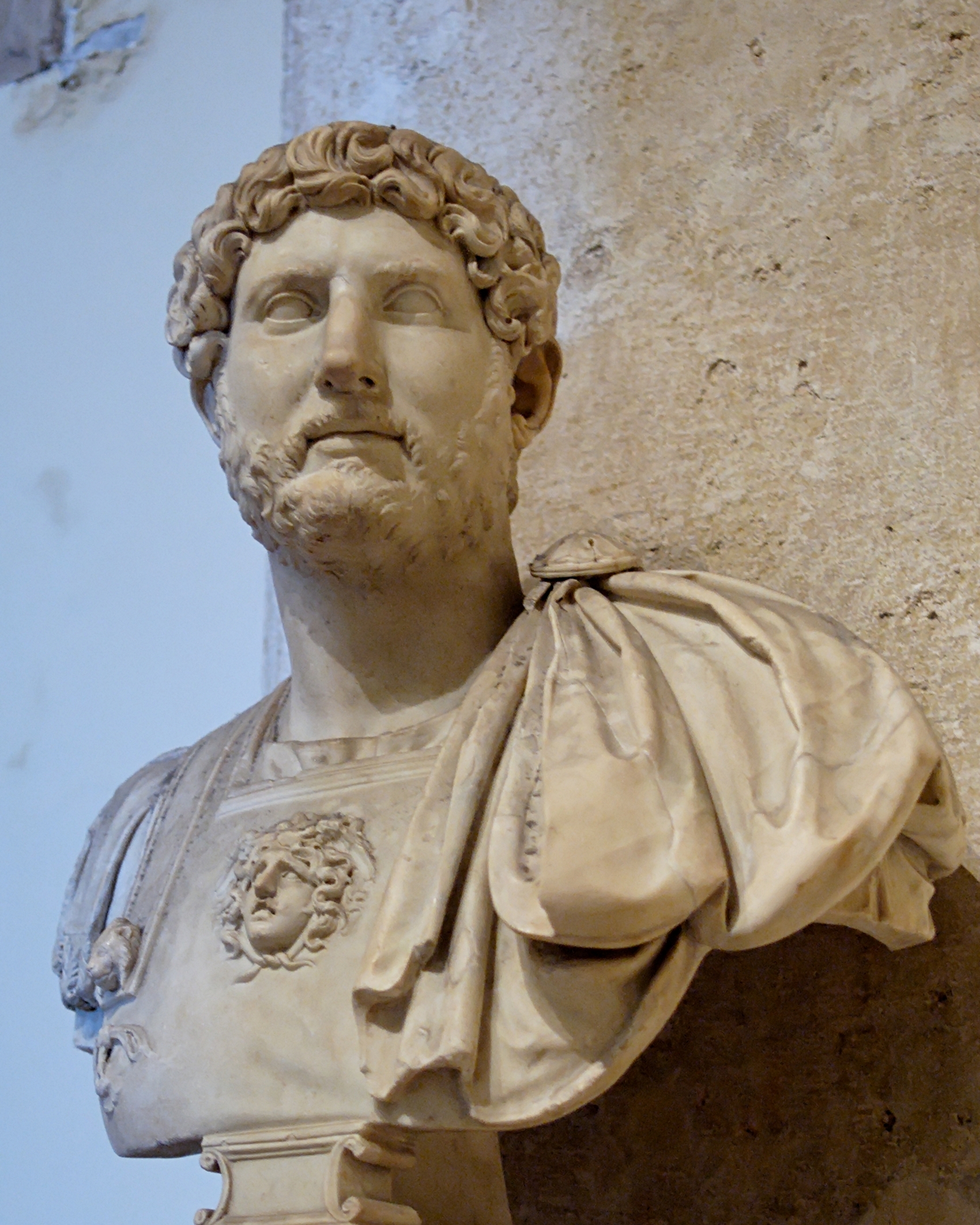
Hadrian, Emperor 117-138 CE
When Hadrian became Caesar in 117 CE it was under controversial circumstances, Historia Augusta 1.4, a rather gossipy work [1], paints the issue of his adoption by Trajan as something of a deathbed scandal. But the machinations described surrounding his ascension to the throne are consistent with the more reliable account of Cassius Dio Historiae Romanae 69.1 [2], which describes the murky circumstances under which he became Emperor. When taken in conjunction with his immediate decisions on the throne to extricate the Empire from Parthia, to reorganize the legions of the east, secure defensible borders, and put down rebellions in recently conquered territories, it looks for all the world to have been something of a consensus move by the powerful in the Military and the government. They wanted to correct the dangerously unsustainable expansionist policies of Trajan that were overtaxing the Empire and had led to the a quagmire in Mesopotamia, an expensive and failing campaign despite the propaganda. Hadrian was the man to do that job.

Monday, March 4, 2013

Matthew and the Antithesis

I have not been very good in updating this blog sight, but today I promise to be better.

One of the most puzzling features of Marcion's antithesis is its seeming use of Matthew. We can see this in Dialogue Adamantius as in these two cases where verses in Matthew's Sermon on the Mount appear to show up in the Antithesis arguments of Megathius, the Marcionite champion:

// The third antithesis found in Dialogue Adamantius 1.12 / 8.12d
Megethius: The Lord brought to view in the Law say, ‘You shall love him who loves you and you shall hate your enemy.” (Leviticus 19:18 LXX with τὸν ἀγαπῶντά σε for τὸν πλησον σου, Matthew 5:43) But our Lord, because He is good, says “Love your enemies, and pray for those who persecute you.” (Matthew 5:44; see also Luke 6:27-28)

Ὁ ἐν τῷ νόμῷ κύριος λέγει·  
ἀγαπήσεὶς σεις τὸν ἀγαπῶντά σε, καὶ μισήσεις τὸν ἐχθρόν σου·
ὁ δὲ κύριος ἡμῶν, ἀγαθὸς ὤν, λέγει·  
ἀγαπᾶτε τοὺς ἐχθροὺς ὑμῶν καὶ εὔχεσθε ὑπὲρ τῶν διωχόντων ὑμᾶς.
In lege deus dicit: Diliges diligentem te, et odio habebis inimicum tuum. Noster autem bonus dominis dicit: Diligite inimicos uestros, et orate pro eis qui persecuntur uos.