Showing posts with label Synoptic Gospels. Show all posts

Saturday, March 9, 2019

Simon Peter and the Cheshire Cat: Was Peter in the "Original" Gospel of John?

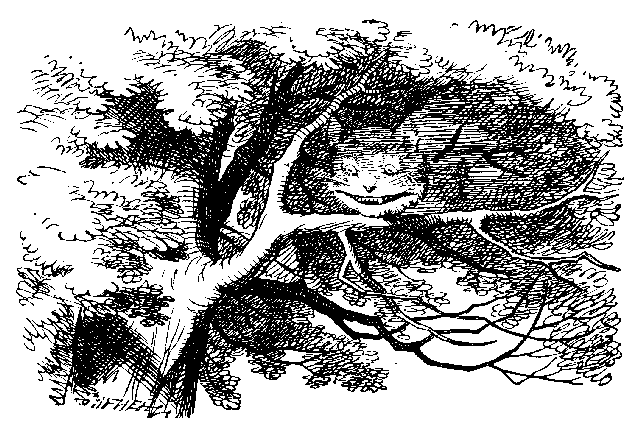
Cheshire Cat fading to smile

... All right,' said the Cat; and this time it vanished quite slowly, beginning with the end of the tail, and ending with the grin, which remained some time after the rest of it had gone.

`Well! I've often seen a cat without a grin,' thought Alice; `but a grin without a cat! It's the most curious thing I ever saw in my life!'

The Cheshire Cat in Lewis Carroll's Alice in Wonderland has the remarkable ability to appear and disappear at will. At one moment he is conversing pleasantly, imparting information Alice already knows, and the next vanishing from sight. Simon Peter performs this very trick before our eyes in the Gospel of John.

Thursday, November 17, 2016

Matthew, the Perverted Gospel of Galatians

Christ and Peter walk on water, 
Fresovo taken from Matthew 14:28-31 
Dura-Europos (mid 3rd century?)


Most scholars when they hear Marcionite priority assume this means that the first Gospel was Marcion's and all other are dependent upon it. But Paul is still regarded generally as before the Gospels. Both assumptions are wrong. Marcionite priority merely means the first publicly circulating Gospel was the Marcionite. The letters of Paul are in earlier form in Marcion's collection, but their relationship to the Gospel is less clear, as we shall see with Galatians. [1]

The entire purpose of the first Gospel was to spread the word of Christ throughout the Roman Empire. And not surprising it was sectarian, the Marcionite Gospel. Other main sect, the proto-Orthodox, quickly found themselves at a disadvantage in this new game of evangelism, where itinerant teachers (Apostles).

Galatians letter presents a picture if a divided movement. One where Paul finds his authority challenged, with rivals dismiss his teachings, and present a completely different version of Christ. This letter, even more clearly in Marcionite form, presents a scenario where the first teachings of Paul have been overturned. What then is this new Christianity Paul confronts?  How is it that this new and different message has become such a threat that it required such strong a response?
Thursday, February 6, 2014

The Mystery of Mark, Part Three, Catholic Editor and/or Author

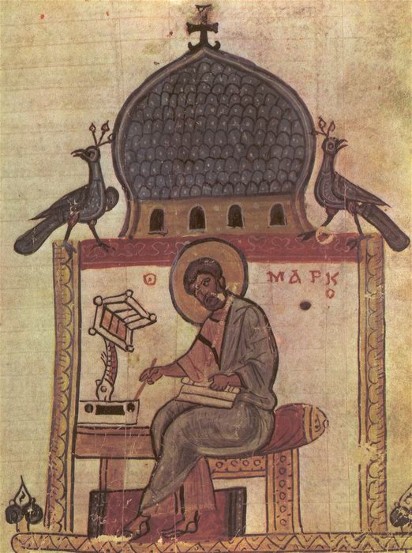
Mark, Slavonic Dobrylo Gospel (1164 CE)
With the completion of my cataloging the unique phrases in the Gospel of Mark I am able to get back to answering the questions about authorship, ending my article writing hiatus. I’d like to say my siesta was the result of the difficult work in compiling the list, but in truth the fault lies more in procrastination. But perhaps that is a good thing after all, as it gave me a chance to reflect and figure out how to present the true nature of the Gospel of Mark.

In compiling the unique phrases and words in Mark I found I had to differentiate between words which are basically a similar word found in another Gospel, which may have more to do with the voice Mark chose or other grammatical need and those which constitute an actual thought or fact which is unique in Mark. The latter are what we are examining here in the context of identifying finally the Catholic editor and the Author.

Wednesday, September 18, 2013

Mystery of Mark, Part One Non-Priority

Mark, Echternach c. 690CE
Mark's non Priority:
The Gospel of Mark poses a difficult problem for me, as there is very little unique material in the book that can be ascribed to Mark. Only a baker’s dozen verses are unique to Mark, and beyond that only a small number of phrases and some individual words. And some of this unique material is most likely part of a later Catholic layer that all books of the New Testament seem to have.

When I look at the Synoptic Problem, the one Gospel which presents a problem is Mark. This may sound surprising, as the bulk of scholarship is focused on the so-called double tradition of Matthew and Luke, trying to explain their common which is in Mark, and thus have determined that Mark has priority. But this assumption is wrong, and leads you to some very bizarre conclusions. [1] The truth is something entirely different and quite surprising.

Wednesday, May 8, 2013

Vocabulary of Luke and Marcion: Commentary on John Knox (1942)

One of the most important books that should have upended Synoptic Study, and yet largely ignored, is John Knox's Marcion and the New Testament (1942). Although the work is largely nothing more than a serious of comments on others work, especially Harnack, with Knox adding nothing more than his opinion of various positions from the sophistry of their words, there is however a unique and important section worth keeping.

For the Gospel of Luke and Marcion's Gospel, Knox has undertaken to to study the vocabulary and try to establish the relationship of Marcion's Gospel and the Gospel of Luke. He developed a table of verses to help illustrate that I provide a link to.

Chapter 4 Marcion's Gospel and the Gospel of Luke is a lot more interesting, when Knox actually gathers evidence and takes a critical eye - lacking in his analysis of the epistles - to the Gospel. In Part III he calls out Sanday's analysis which underpinned the opinions of Burkett and Plummer, as well as paralleled in some sense Harnack's, who held that Marcion's Gospel was not prior to Luke.