 |
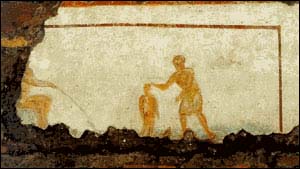
| Baptism of Christ, 3rd century, Catacomb of Callixtus |
Monday, December 17, 2018
The Sudden Appearance of John in the Marcionite Gospel


Friday, February 17, 2017
Philemon: My Reading
 |
 87: Papyrus 87, recto, Philemon 24-25, c 250 CE 87: Papyrus 87, recto, Philemon 24-25, c 250 CE |
the epistle, "To this epistle alone did its brevity avail itself against the falsifying hands of Marcion," [2] And so I have found in this letter, like all the others, a layer of material, albeit smaller in this brief one, with a distinct Catholic flavor. To be fair the Catholic text as Tertullian knew it may not have included some of the material we have today. Only small scraps survived from before the Decian [3] persecution, so we can only guess the content of the text before the mid 3rd century.
Philemon is no different than any other Pauline text. Even in it's brief form it possesses openings, closings, and formulas from additional hands. The Marcionite construction could not assume the content. But a lack of Patristic commentary meant that my efforts had to rely upon the vocabulary,
Tuesday, February 14, 2017
Colossians: The Image of the Invisible God
.jpg) |
| Colossians, Codex Harleianus 5557 (Minuscule 321) |
The Ephesians Parallel
One of the features of our received text are the parallels between Colossians and Ephesians. But a funny thing happened in working through the reconstruction of Marcionite Laodiceans; all the parallel passages with Colossians vanished - excepting the common Marcionite opening and closings of all the letters in the collection. This should perhaps not be a great surprise, as Winsome Munro, Authority in Paul and Peter, had long identified Ephesians 5;15-18a, 5:21-6:9 and the parallel passages of Colossians 3:18-4:1, 4:5 as part of the pastoral stratum.
Thursday, November 17, 2016
Matthew, the Perverted Gospel of Galatians
 | |||||||
| Christ and Peter walk on water, Fresovo taken from Matthew 14:28-31 Dura-Europos (mid 3rd century?) |
The entire purpose of the first Gospel was to spread the word of Christ throughout the Roman Empire. And not surprising it was sectarian, the Marcionite Gospel. Other main sect, the proto-Orthodox, quickly found themselves at a disadvantage in this new game of evangelism, where itinerant teachers (Apostles).
Galatians letter presents a picture if a divided movement. One where Paul finds his authority challenged, with rivals dismiss his teachings, and present a completely different version of Christ. This letter, even more clearly in Marcionite form, presents a scenario where the first teachings of Paul have been overturned. What then is this new Christianity Paul confronts? How is it that this new and different message has become such a threat that it required such strong a response?
Thursday, June 18, 2015
The Trouble with Sources - Never Salute a Marcionite
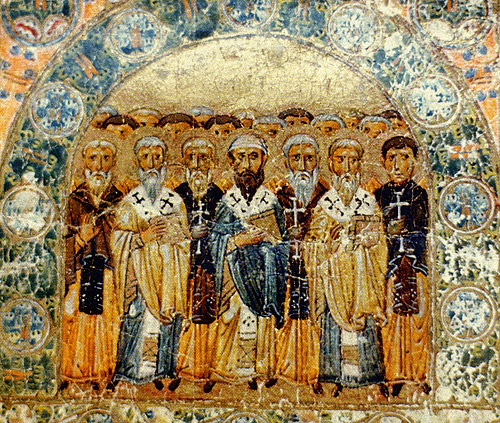 |
| The Church Fathers, an 11th-century Kievan miniature from Svyatoslav's |
Yet it is Dialogue Adamantius which is the most difficult. John Clabeaux states (page 12, A Lost Edition of the Letters of Paul),
'The Dial. Adam. is clearly artificial (Adamantius Dialogue xv). There are two claims by the title character (1.5 and 5.22) that he used a Marcionite Apostolikon. These claims, in light of the research of this study, are untenable. The author's claims, even if they are taken seriously, contain two major limitations: They do not speak for every Pauline citation in Dial. Adam.; and (2) when Adamantius says "ἐκ τοῦ αὐτῶν ἀποστολικοῦ" (5.22), he may merely be referring to those letters of Paul which the Marcionites accepted, without implying a reference to the text that is in fact used (catholic or Marcionite).'
Monday, March 30, 2015
John The Baptist: From the Marcionite to the Canonical
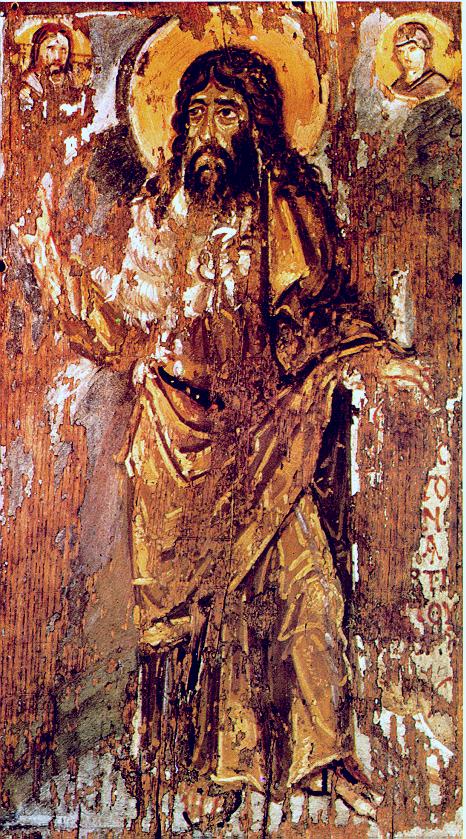 |
| John the Baptist, 6th Century Icon St. Catherine at Mt. Sinai |
The Evolving Character of John the Baptist
The character of John the Baptist figures prominently in the Gospels. We are all familiar with the scene on the Jordan where John is Baptizing, and then when Jesus is Baptized the sky opens and a voice is heard. And we are familiar with the Malachi and Isaiah references that introduce John and his preaching. But this is information that can get in the way of understanding how the character came to be so prominent in the Gospels and understanding how his role started and evolved.
So for this presentation, I am going ask you to forget everything we think we know about John and start with a fresh reading, as if for the first time. Beginning the Marcionite Gospel, and analyzing only what we find in that Gospel to understand John within the context of that writing. From there we will expand into the other Gospels to see how the character developed.
Friday, June 6, 2014
The Gospel of John: Context of Authorship
 |
| John, Book of Kells (800 CE) |
In surveying the content of the Gospel of John today with knowledge of the second century controversies, I am struck by the consistent and blunt repudiation of the Jewish God as the father of Christ, and more generally its opposition against every Jewish Christian theological point we find presented in the rest of the New Testament. It is truly a wonder this book, even with redaction, ever made it into canon.
Subscribe to:
Posts (Atom)