Thursday, February 6, 2014

The Mystery of Mark, Part Three, Catholic Editor and/or Author

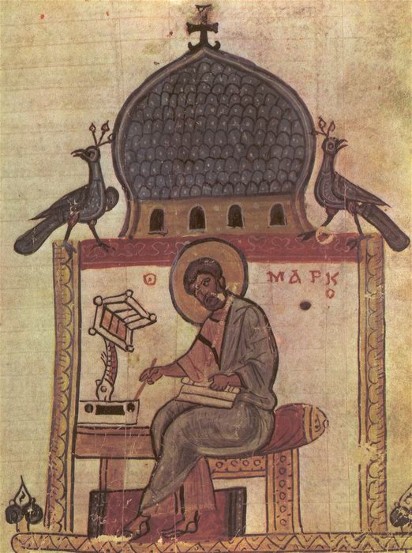
Mark, Slavonic Dobrylo Gospel (1164 CE)
With the completion of my cataloging the unique phrases in the Gospel of Mark I am able to get back to answering the questions about authorship, ending my article writing hiatus. I’d like to say my siesta was the result of the difficult work in compiling the list, but in truth the fault lies more in procrastination. But perhaps that is a good thing after all, as it gave me a chance to reflect and figure out how to present the true nature of the Gospel of Mark.

In compiling the unique phrases and words in Mark I found I had to differentiate between words which are basically a similar word found in another Gospel, which may have more to do with the voice Mark chose or other grammatical need and those which constitute an actual thought or fact which is unique in Mark. The latter are what we are examining here in the context of identifying finally the Catholic editor and the Author.

Thursday, October 24, 2013

The Minimalist Approach to Marcion

Genndy Tartakovsky's Minimalist Samarai Jack
While I on and off toil away with part two, the Catholic Editor, of my three part analysis of who wrote Mark, I came in conversation with David Inglis and came up with a quick topic that needs to be addressed concerning my Interlinear reconstructions of the Marcionite text. My interlinear reconstructions seem to baffle traditionalists, because I follow a minimalist approach, but in a way that turns their world view upside down. Like Genndy Tartakowsky's fantastic cartoon, in an effort to tell the cleanest story, everything that is not required is cut away, and what is left is the purest of pure forms. And I am extremely conservative in my approach, because I do not accept any uncertain assumptions. As with the image of Jack and Aku, there may be many detail items missing, and yet no clearer picture of these characters can be had.

Monday, September 30, 2013

Another Apocalypse from the Kitos Era?

In my last article on changing the title description I tackled the mini-Apocalypse from Luke. My placement of of the after the Tumulto Iudaico was in part based on the phrase, "People will rise up against People, and Kingdom against Kingdom" (Ἐγερθήσεται ἔθνος ἐπ' ἔθνος καὶ βασιλεία ἐπὶ βασιλείαν). Unfortunately in my analysis I forgot one important potential and even possible source for the phrase, the document known as 4 Ezra (Greek Προφήτης Εσδρας or Αποκάλυψις Εσδρα) has much the same phrases found in 2 Ezra 13:31 - the English and surviving Latin (Vulgate) below,
And they shall plan to make war against one another,
city against city, place against place, people against people, and kingdom against kingdom
et in alisalio cogitabunt bellare,
civitates civitatem et locus locum et gens ad gentem et regnum adversus regnum
There is a problem, in that this document is considered, and for very good reasons to be dated from about 100 CE, some 15 years  too early to be aware of either the Parthian War or the Tumulto Iudaico. So what is going on here, have I missed something?
Sunday, September 22, 2013

Changing the Blog Title Description to Post Kitos War

Every now and again in my studying the development of Christianity I stumble over some fact or event which over throws a good portion of the work I have done. It is extremely frustrating to face, but I like to think I am less pig headed and more scientific than most. I know certain so-called scholars will spend years attempting to belittle the evidence arrayed against their pet position, or end run it, rather than face the fact that much of their work is lost. For me, this happened in the mid-1990s and what I was doing was so off base I care not to even acknowledge it today. [1] But in the scientific model its all part of finding the truth. And so it is today that I conclude one of my blogs fundamental assumptions is wrong. Fortunately the impact is mostly to a couple charts and the description at the top of the page. Whatever else is simply a matter of adjusting a footnote here and a comment there, nothing to major.

Wednesday, September 18, 2013

Mystery of Mark, Part One Non-Priority

Mark, Echternach c. 690CE
Mark's non Priority:
The Gospel of Mark poses a difficult problem for me, as there is very little unique material in the book that can be ascribed to Mark. Only a baker’s dozen verses are unique to Mark, and beyond that only a small number of phrases and some individual words. And some of this unique material is most likely part of a later Catholic layer that all books of the New Testament seem to have.

When I look at the Synoptic Problem, the one Gospel which presents a problem is Mark. This may sound surprising, as the bulk of scholarship is focused on the so-called double tradition of Matthew and Luke, trying to explain their common which is in Mark, and thus have determined that Mark has priority. But this assumption is wrong, and leads you to some very bizarre conclusions. [1] The truth is something entirely different and quite surprising.

Saturday, August 31, 2013

The Votes Are In! The Next Topic: Who Wrote Mark?


Now from your voting it seems pretty clear you want me to write about the Gospel of Mark, where it fits and who wrote it. This is the most difficult and involved project of the choices, but  I accept the challenge.

The Gospel of Mark poses a unique problem for me, as there is very little unique material in the book that can be ascribed to Mark. Only a baker’s dozen verses are unique to Mark, and beyond that only a small number of phrases and some individual words. And some of this unique material is most likely part of a later Catholic layer that all books of the New Testament seem to have. As I write this I do not have the answers, and I think this will be a journey of discovery for all of us. I'll try to get the first  of what will probably be a two or three part work up before the Labor Day weekend is up. No promises however.

Sunday, August 18, 2013

Marcionite Philippians Interlinear and Notes

Chester Beatty p46 Philippians & Galatians
In the Marcionite Apostolikon Paul's Epistle to the Philippians is a rather minor book, less than half the size of the Catholic version in our bibles today. My reconstruction of Marcionite form, or rather Marcionite plus indeterminate verses, results in a mere 46 verses, and could have been much smaller, as 36 of these verses are not attested. I erred on the side of caution leaving in some questionable phrases and verse. The small size of Philippians suggests the the Marcionite Epistles were arraigned from largest to smallest, excepting Galatians which was the heralding letter giving the stamp of authority on the collection, much like the Catholic collection. But to arrive at that order, the Thessalonians have to be considered one letter, probably also the Corinthians.

Philippians is now the fifth book I have completed a reconstruction in Marcionite form. Although I have a much better handle on the specifics of the targets of the content and a better eye for the Catholic editor's themes and words, there were still several unique challenges faced in the reconstruction this book in Marcionite form. Unlike other books in Marcion's collection I have reviewed, Philippians has no additional attestation beyond Tertullian, and it is the last book that Tertullian looked at and may have skipped over more material than usual. Below I go over a  few interesting points.